
The pros and cons of outsourcing your accounting come down to cost, control, expertise, security, and timing. For many small business owners, outsourced accounting services can reduce overhead costs and give better financial reporting. For others, the wrong accounting service provider can create communication gaps, unclear fees, or too little control over sensitive financial data.
In this article, we explore what outsourced accounting includes, when it helps, where it can go wrong, and how a business owner can choose the right accounting service provider without losing control of the numbers.
Pros and Cons of Outsourcing Your Accounting
The pros and cons of outsourcing your accounting depend on what you need help with. Basic outsourcing bookkeeping is different from a full outsourced finance department that covers bookkeeping services, payroll, accounts receivable, tax filing, CFO services, reporting, and advisory services.
For a small business, the biggest benefit is usually access to a trained team without the fixed cost of hiring, training, and managing accounting staff. The Bureau of Labor Statistics reported that bookkeeping, accounting, and auditing clerks had a median annual wage of $49,210 in May 2024, while accountants and auditors had a median annual wage of $81,680 in May 2024. That’s before benefits, payroll taxes, software, management time, and turnover risk enter the picture.
But here’s the thing: outsourced accounting doesn’t remove your responsibility as the business owner. “Regardless of who prepares the tax return, the taxpayer is responsible for all the information on it,” the IRS says in its guidance on choosing a tax professional. That one sentence should shape how you pick any accounting outsourcing service. You can delegate the work, but you can’t stop paying attention.
What Outsourced Accounting Services Usually Include
Outsourced accounting services can be narrow or broad. Some providers only handle monthly reconciliations and basic outsourced accounting bookkeeping. Others act as an outsourced finance and accounting team with controller-level review, CFO services, payroll processing, tax planning, and cash flow support.
For PBTSI, the value is not only outsourced bookkeeping. The company is built around a full-service outsourced accounting department that brings bookkeeping, payroll, HR, tax, CFO advisory, automation, and reporting into one connected system. That matters for business owners who are tired of dealing with a separate bookkeeper, payroll processor, HR tool, tax preparer, and finance advisor.
That matters because the phrase “outsourced accounting” can mean very different things. A $500 monthly bookkeeping service won’t give the same support as an outsourced finance department. Likewise, a tax preparer may not manage accounts receivable, payroll tax compliance, or month-end financial reporting. Before you judge the pros and cons of outsourcing your accounting, define the work first.
| Accounting need | Basic outsourced bookkeeping | Full outsourced finance and accounting |
| Bank and credit card reconciliation | Usually included | Included with review |
| Accounts receivable and payable | Sometimes included | Often included |
| Payroll processing | Usually separate | Often part of the package |
| Tax filing and tax compliance | Usually separate | Often coordinated |
| Cash flow reports | Basic reports only | Deeper financial analysis |
| CFO services | Rare | Often available |
| Internal controls | Limited | More structured |
| Business growth advice | Limited | Often part of advisory support |
Need a clearer financial system without hiring a full in-house team? PBTSI’s full-service accounting support helps business owners compare bookkeeping, payroll, tax, and CFO advisory under one organized model.
Outsourcing Bookkeeping: Benefits and How It Works
Outsourcing bookkeeping usually starts with access. The business connects bank accounts, credit cards, payroll systems, sales platforms, or accounting software to the outsourced provider’s workflow. The provider then reviews transactions, categorizes income and expenses, reconciles accounts, prepares reports, and flags issues that need owner approval.
The best outsourced accounting teams do not just “close the books.” They build a rhythm. That rhythm may include weekly transaction review, monthly reconciliations, management reports, tax document checks, payroll review, and periodic advisory calls. For a business owner, that rhythm can be the difference between finding out about a cash flow problem early and discovering it after the bank account already feels tight.
The benefits of outsourcing accounting and bookkeeping are strongest when the provider has clear systems. Cloud-based accounting software can help owners see reports in real time. Secure portals can keep sensitive financial information out of email threads. Scheduled review calls can help business owners make informed decisions before tax season, or a loan application creates pressure.
PBTSI’s model fits that need because it combines remote support, automation, secure cloud collaboration, and cross-trained accounting roles. The company describes its approach as modern accounting powered by automation, with bookkeeping, payroll, HR, tax, and CFO advisory in one remote system through PBTSI’s outsourced accounting department.
The Advantages of Outsourcing Bookkeeping and Accounting
The first advantage is cost control. Outsourcing accounting can be cost-effective because you pay for the service level you need rather than a salary that stays fixed even when the workload changes. There’s no recruiting cost, no benefits package, no paid time off, and no software setup headache for an internal hire. For owners who are still watching every dollar, that can help.
The second advantage is access to expertise. A single in-house bookkeeper may be good at daily accounting tasks but weaker in tax compliance, payroll, financial analysis, or regulatory compliance. Outsourced accounting teams often bring bookkeepers, reviewers, payroll professionals, tax specialists, and advisory staff into one business process. That gives a company more coverage than one person can offer.
The third advantage is better time use. Bookkeeping and accounting outsourcing can free business owners from work that steals focus from sales, operations, and business growth. When owners spend Sunday night sorting receipts, checking invoices, or trying to fix messy books, the company pays for that lost time in quiet ways. Outsourcing these tasks can help the owner get back to the core business.
The fourth advantage is stronger reporting. Many business owners don’t need more data; they need cleaner data. Cloud-based accounting software, real-time dashboards, monthly financial reports, and scheduled review calls can turn financial data into decisions. PBTSI says its model uses automation for real-time transaction syncing, error detection, deadline reminders, digital document management, and predictive insights.
The fifth advantage is reduced reliance on one person. A small in-house accounting department can become fragile. One employee gets sick, leaves, or falls behind during tax season, and the books stall. A cross-trained outsourced partner can reduce that bottleneck. PBTSI describes its team as cross-trained across bookkeeping, payroll, CFO advisory, and tax, with a remote-enabled model built to avoid service interruptions.
There’s also a fraud-control angle. Small organizations often have fewer anti-fraud controls than larger ones, according to the Association of Certified Fraud Examiners’ 2024 Report to the Nations, which studied 2,402 occupational fraud cases across 143 countries and territories. Outsourced accounting doesn’t magically prevent fraud, but it can add review, segregation of duties, and outside visibility where a small internal team has weak checks and balances.
The Disadvantages of Outsourcing Accounting Services
Now for the other side. The pros and cons of outsourcing your accounting are not balanced unless you look hard at the risks.
The first risk is loss of control. Some business owners like to see the person who handles their books, ask questions on the spot, and make quick changes during the day. With an external accounting service provider, you need a process. That may include scheduled calls, portal messages, monthly reviews, and agreed response times. If the provider is slow, vague, or hard to reach, frustration builds fast.
The second risk is scope creep. Outsourced accounting services often start with one clean package, but the real work can expand. Cleanup, tax notices, payroll corrections, sales tax filings, extra reporting, and urgent financial analysis may cost more. A fair provider will explain this upfront. A poor provider will bury it in fine print.
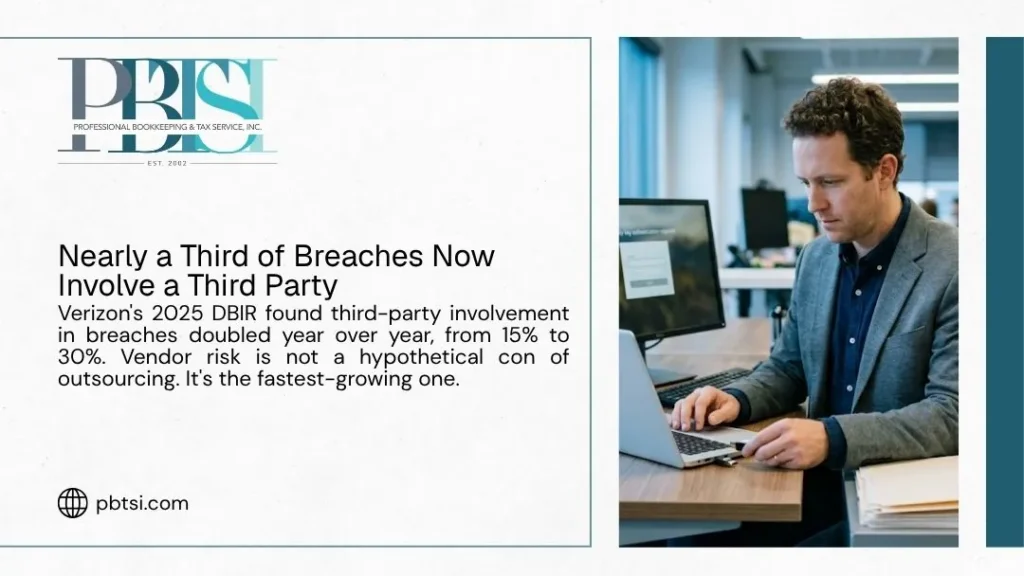
The third risk is data security. Accounting outsourcing requires access to bank feeds, payroll data, tax documents, employee records, vendor files, and sometimes customer details. The FTC tells businesses to build a data security plan around five principles: know what data you have, keep only what you need, protect it, dispose of what you no longer need, and plan for incidents. Before you outsource accounts, ask how the firm handles data protection, access permissions, password controls, document uploads, and staff access.
The fourth risk is communication. Time zones, language barriers, unclear handoffs, and a weak onboarding process can make outsourced accounting services feel distant. This is especially true with offshore accounting process outsourcing where your team and the provider don’t share working hours. That doesn’t mean offshore support is bad. It means the rules need to be clear before the work starts.
The fifth risk is poor fit. Some outsourced accounting firms are built for startups. Some are built for healthcare, restaurants, construction, nonprofits, ecommerce, or professional services. A provider that doesn’t understand your accounting software, revenue model, payroll setup, or compliance needs may create more work than it removes.
| Possible disadvantage | Why it matters | How to reduce the risk |
| Loss of control | Owners may feel removed from day-to-day operations | Set review calls, response times, approval rules, and dashboard access |
| Hidden fees | Cleanup, tax notices, and special reports can raise costs | Ask for a written scope and out-of-scope rate card |
| Data security concerns | Sensitive financial information leaves your internal team | Require secure portals, limited access, encryption, and written policies |
| Communication gaps | Slow answers can delay business decisions | Agree on channels, deadlines, and escalation steps |
| Weak industry fit | Wrong processes can hurt reporting and tax compliance | Choose a provider with experience in your business type |
CPA Firms vs. Outsourced Accounting
A CPA firm and an outsourced accounting provider can overlap, but they are not always the same thing. A CPA firm may focus on tax preparation, audits, reviews, and higher-level compliance. An outsourced accounting service may focus on daily bookkeeping, payroll support, monthly close, cash flow reporting, and management reports. Some firms offer both. Some do not.
This is where business owners need to be careful. If you only need year-end tax filing, a tax-focused provider may be enough. If your books are late every month, payroll is messy, and you do not know whether the company is profitable by service line, you may need outsourced finance and accounting support, not just a tax preparer.
PBTSI’s model sits closer to a full outsourced finance department because its service mix covers bookkeeping, payroll and HR, CFO advisory, tax services, reporting, compliance support, and automation. Its transparent pricing lists bookkeeping from $1,000 per month, payroll and HR from $1,500 per month, CFO advisory from $1,500 per month, tax services from $900 per filing cycle, and a full-service accounting department from $3,500 per month.
| Business need | CPA firm may fit | Outsourced accounting may fit |
| Annual tax return | Strong fit | Sometimes included |
| Monthly bookkeeping | Sometimes | Strong fit |
| Payroll processing | Sometimes | Strong fit when included |
| Day-to-day financial operations | Limited unless offered | Strong fit |
| CFO-level planning | Sometimes | Strong fit when advisory is included |
| Secure document workflow | Often | Strong fit with a client portal |
| Ongoing business visibility | Depends on the firm | Strong fit with monthly reporting |
In-House Accounting vs an Outsourced Finance Department
A small company doesn’t always need to choose one side forever. Some keep a part-time internal admin and use outsourced accounting services for higher-level review. Others outsource everything until the business grows enough to justify an internal controller. The smart move is to match the model to the stage of the business.
If your business has simple transactions, low payroll complexity, and clean books, basic outsourced accounting may be enough. If your business is growing, hiring, expanding across states, raising capital, or trying to improve cash flow, outsourced finance and accounting services may make more sense.
PBTSI’s pre-qualification form asks practical questions that mirror this decision: annual revenue, current accounting setup, support needed, confidence in financials and tax filings, time to receive monthly financials, current systems, biggest challenges, future changes, budget, and timeline. That’s a useful model because it screens for fit before the sales call.
| Business situation | Better fit | Reason |
| Owner only needs monthly bank reconciliation | Basic outsourced accounting service | Lower cost and simple scope |
| Business has messy books or no reports | Outsourced accounting cleanup plus ongoing bookkeeping | Fixes the foundation first |
| Company has payroll, HR, tax, and reporting gaps | Outsourced finance department | One team can manage linked financial processes |
| Owner wants daily in-person access | In-house accounting staff | Better proximity and direct control |
| Company needs forecasting and growth planning | Outsourced CFO services | Gives strategic insight without a full-time CFO |
| Business handles highly sensitive or regulated data | Hybrid model or carefully vetted provider | Keeps control while adding expertise |
How to Choose an Accounting Service Provider
Choosing the outsourced accountant shouldn’t feel like buying software with a blindfold on. Ask plain questions. Who touches the books? Who reviews the work? What accounting software do you use? How do you protect financial data? What is included in the monthly fee? What happens during tax season? How often will I see reports? What response time can I expect? Who owns the files if we leave?
A strong accounting services provider should also explain its onboarding process. PBTSI says its process includes discovery and goal setting, technology setup, ongoing support, and growth guidance. Its client center also gives clients secure portal access for documents, reports, payment, and communication history.
PBTSI’s pre-qualification process asks about annual revenue, current accounting setup, support needed, confidence in financials and tax filings, time to receive monthly financials, current systems, biggest challenges, future changes, budget, and timeline. That kind of screening helps both sides decide whether the service level fits before work starts.
Should I Outsource My Accounting?
You should consider outsourcing accounting if your financial records are late, your tax filing process feels chaotic, your cash flow reports are unclear, or your current setup depends too much on one person. You should also consider it if you’re searching for outsourced accounting services near me but don’t actually need someone down the street. With cloud-based accounting software, secure portals, and structured review calls, location matters less than process, access, and accountability.
You may not be ready to outsource accounting work if you don’t know what you want the provider to handle. A vague request such as “fix my accounting” can lead to mismatched expectations. Start with the outcome. Do you need clean books? Better cash flow? Payroll compliance? Tax planning? CFO-level guidance? Internal controls? Faster monthly close? Once you know the problem, the right accounting outsourcing solutions become easier to compare.
The pros and cons of outsourcing your accounting are clearest when you look at the next twelve months. If the business grows, will your current setup hold up? If your bookkeeper leaves, who steps in? If the IRS sends a notice, who gathers the files? If payroll goes wrong, who fixes it? If you need a loan, will your financial statements be ready?

FAQs About Outsourcing Your Accounting
What is the process of outsourcing accounting?
The process usually starts with a review of your current books, accounting software, payroll setup, bank accounts, tax deadlines, and reporting needs. After that, the provider sets up access, builds a monthly workflow, reconciles accounts, prepares reports, and schedules review points. A full outsourced finance and accounting provider may also support payroll, HR, tax compliance, cash flow reports, and CFO advisory.
What is the benefit of an outsourced accountant?
The main benefit of an outsourced accountant is access to accounting expertise without the cost of hiring a full-time employee. A strong provider can help with bookkeeping, financial records, tax preparation, payroll processing, reporting, and business decisions. The right outsourced accountant can also give business owners more time to focus on growing the company.
What does an outsourced accounting department actually do?
An outsourced accounting department can handle the financial tasks that an internal accounting department would normally manage. Services may include bookkeeping, reconciliations, accounts receivable, accounts payable, payroll, tax filing support, financial reporting, cash flow analysis, and CFO services. In PBTSI’s case, the model is built around a full-service partner for bookkeeping, payroll, HR, CFO advisory, and tax.
Is outsourced accounting better than hiring a part-time bookkeeper?
It depends on the business. A part-time bookkeeper may work well for a simple company with few transactions. Outsourced accounting may be better when the business needs more structure, review, payroll support, tax coordination, reporting, or advisory services. If the company is growing, a full outsourced finance department can provide more coverage than one part-time role.
How do I know if an accounting service provider is trustworthy?
Look for clear pricing, secure document systems, defined response times, qualified staff, written scope, review procedures, and plain-language communication. Ask how the provider protects sensitive financial information, who reviews the work, and how often you will receive reports. A trustworthy provider should answer those questions without making the process feel confusing.
A Better Way to Make the Call
The pros and cons of outsourcing your accounting don’t point to one answer for every business. They point to a better question: what level of financial support does the business need now, and what will it need next?
For some owners, accounting outsourcing is mainly about saving time and money. For others, it’s about better financial health, stronger internal controls, cleaner reports, and access to financial insight they can’t get from a basic bookkeeping setup. The benefits of outsourcing accounting services are strongest when the provider is clear, secure, experienced, and involved enough to help you make informed decisions.
Still, don’t outsource your accounting just because it sounds easier. Review the scope. Ask about data security. Confirm who reviews the work. Check whether tax compliance, payroll processing, accounts receivable, and CFO services are included or separate. Make sure the price fits the value.
If your business has outgrown scattered spreadsheets, late reports, and too many disconnected vendors, PBTSI may be worth a closer look. You can contact PBTSI to discuss whether a full-service outsourced accounting department fits your current stage, budget, and growth plans.
Done well, outsourcing isn’t a handoff and a prayer. It’s a cleaner financial system, a steadier rhythm, and a better way to see what’s really happening in the business before the numbers start shouting.