
Some federally funded or assisted construction contracts require contractors and subcontractors to submit weekly certified payroll reports. The U.S. Department of Labor’s Davis-Bacon and Related Acts overview explains the federal framework. A report documents covered workers’ classifications, hours, wages, fringe benefits, deductions, and the contractor’s signed Statement of Compliance.
Below is the process in the order you will actually do it: confirm the rules, find the right wage rates, complete each part of the report, sign it, and submit it. The common mistakes that trigger agency problems are at the end.
What Certified Payroll Is and When You Need It
Certified payroll is a weekly payroll report, signed under a Statement of Compliance, showing that every laborer and mechanic on a covered project was paid at least the prevailing wage for their classification.
Federally, the requirement comes from the Davis-Bacon Act and Related Acts, which cover federally funded or federally assisted construction. Many states, counties, and cities have their own prevailing wage laws, often with separate forms, deadlines, and submission systems. One project can fall under both federal and state rules.
Two points catch contractors off guard:
- Coverage depends on the contract and work performed. Contractors and subcontractors performing covered work must report covered laborers and mechanics. Lower-tier status alone does not exempt a subcontractor; confirm the requirements in the contract and with the contracting agency.
- Federal reporting is weekly. Submit a report for each week covered work is performed, following the agency’s instructions for any weeks with no covered work.
Confirm the Rules Before the First Payroll
Before payroll starts, confirm these project requirements:
1. Is this a federal, state, or local project? The governing law determines the form, deadline, and submission system. State and local rules can apply alongside federal requirements. 2. Which wage determination is incorporated into the contract? Record its number and modification. The contract and contracting agency determine which version applies; do not change rates based only on a newer version you find online. 3. How does the agency want reports delivered? Check whether reports go through a portal, to the prime contractor, or directly to the contracting agency. 4. Are there project-specific requirements? Ask the prime contractor or agency about earlier internal deadlines, attachments, and “no work” reports. Keep the answers with the project records.
Prevailing Wage Rates and Worker Classifications
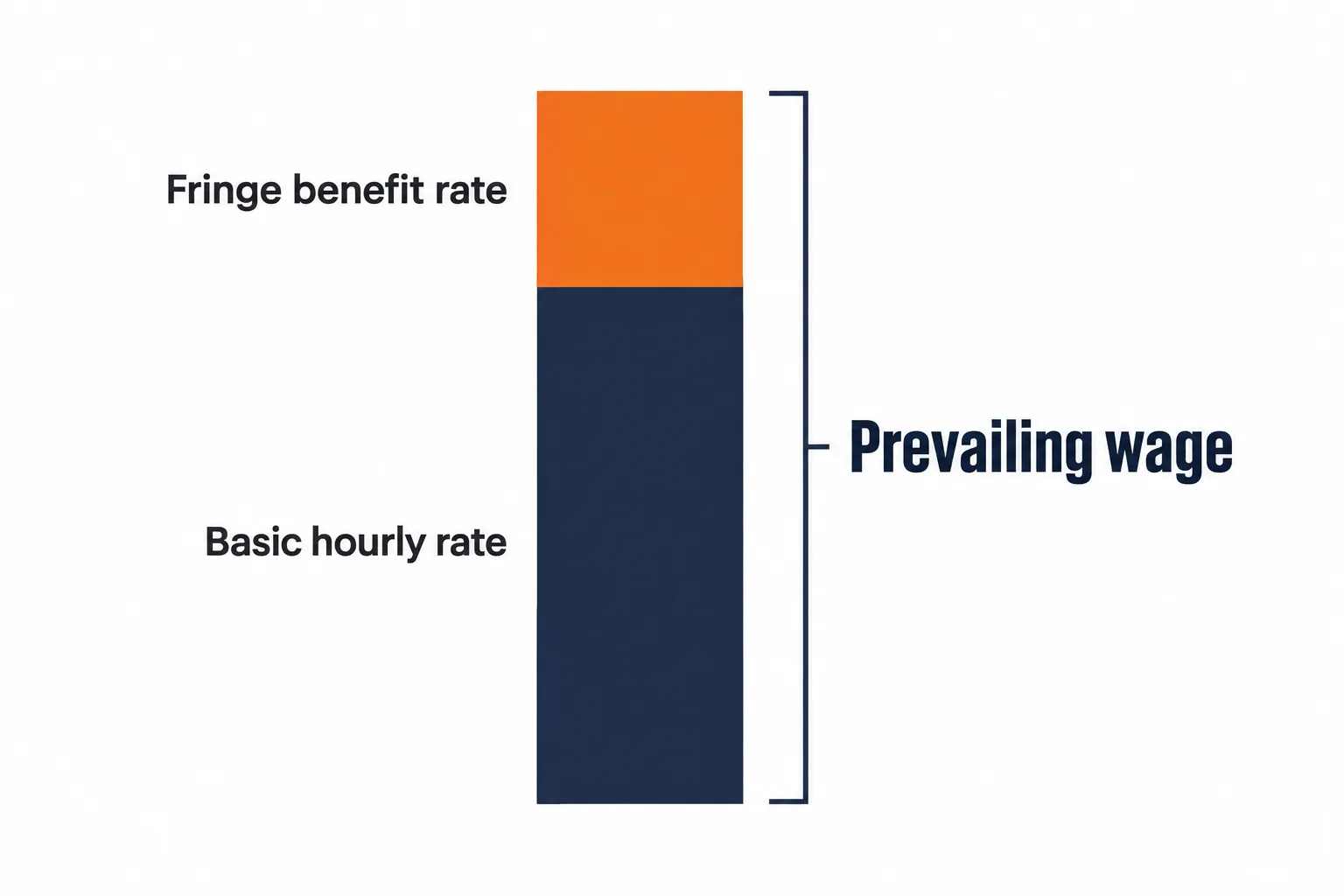
The federal Davis-Bacon and Related Acts generally cover construction, alteration, and repair work on federally funded or assisted contracts in excess of $2,000. The applicable contract wage determination lists the minimum wage and fringe requirements for covered classifications. Thresholds and coverage can differ under other federal, state, or local laws.
What a prevailing wage includes
Each classification on a wage determination typically lists two amounts:
- A basic hourly rate, the minimum cash wage per hour.
- A fringe benefit rate, an additional amount that may be provided through qualifying benefits, as cash, or a combination.
Meet the full wage-and-fringe obligation for every covered hour, while also meeting any applicable minimum cash-wage requirement. Only qualifying fringe benefits can be credited.
Finding the right determination
Federal wage determinations are published on SAM.gov. Use the determination incorporated into your contract and ask the contracting agency about any modification or direction to use a different version.
Classifying workers correctly
Classify each worker by the work they actually perform, not by job title. Someone hired as a laborer who spends a day running equipment may be owed the operator rate for those hours.
When a worker splits time across classifications, you can generally pay each classification’s rate for the hours spent in it, but only if daily time records clearly show how the hours were divided. Without that documentation, the agency may question the classification and wage calculation.
If the wage determination does not list a classification needed for the work, do not select a “close enough” rate on your own. Ask the prime contractor or contracting agency about the required conformance process before paying that classification.
Apprentices: Registration, Wage Rates, and Ratios
An apprentice may be paid the applicable program rate below the journeyworker rate only when individually registered in an apprenticeship program registered with the U.S. Department of Labor or a recognized State Apprenticeship Agency, and employed under that program’s standards. Confirm the applicable program level, wage rate, and apprentice-to-journeyworker ratio for the project. Do not assume a general “trainee” rate applies; check the contract and current agency guidance.
How to Do Certified Payroll Step by Step
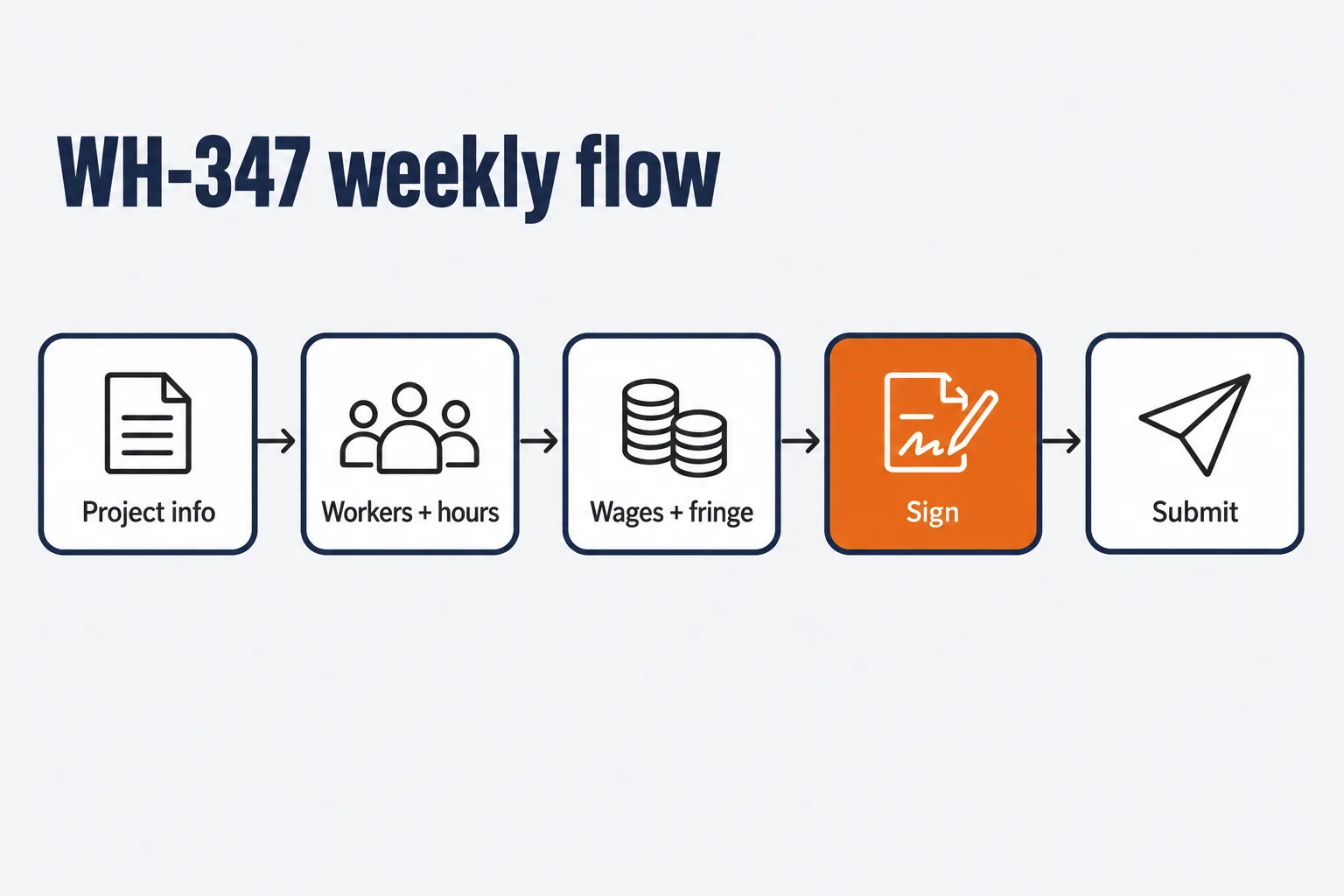
These steps follow Form WH-347, the federal certified payroll form. Using WH-347 itself is optional on federal projects if your alternative report contains all required information and is accompanied by the required Statement of Compliance with identical wording. Check the official WH-347 form and instructions and use the current version.
Step 1: Enter Contractor and Project Information
Start each report with:
- Your company name and address, and whether you are the prime contractor or a subcontractor
- Project name and location
- Contract or project number
- Payroll number (numbered consecutively, starting with 1)
- Week-ending date
Mark the last report for the project clearly as the final payroll so the agency knows your reporting is complete.
Step 2: List Each Worker and Their Classification
For each worker on the project that week, enter:
- Their name and an identifying number. Use a limited identifier such as the last four digits of the Social Security number, never the full SSN.
- The classification, worded exactly as it appears on the wage determination.
- Apprentice or trainee status, with program level where applicable.
Step 3: Record Daily Hours, Including Overtime
Enter straight-time and overtime hours separately for each day of the workweek. Daily detail supports your totals, split classifications, and overtime calculations.
For many covered federal contracts, the Contract Work Hours and Safety Standards Act (CWHSSA) requires at least one and one-half times the worker’s regular rate for hours over 40 in a workweek. It applies only to contracts above specified thresholds, generally over $100,000, or $150,000 for certain FAR-covered prime contracts. Fair Labor Standards Act overtime may apply separately. Verify the contract and the correct regular-rate calculation; do not assume a single overtime formula applies to every fringe arrangement.
Only hours worked on the covered project go on this project’s report. If a worker also worked other jobs that week, their total gross pay still has to reconcile, which is why the form asks for both project earnings and total gross wages.
Step 4: Calculate Wages and Fringe Benefits
Enter the hourly rate paid and gross earnings for the project, then account for the fringe portion. You can meet the fringe obligation through:
- Contributions to qualifying bona fide benefit plans, such as health insurance or retirement plans
- Cash in lieu of benefits, paid directly to the worker
- A combination of qualifying plan contributions and cash
Illustrative example only (placeholder numbers): A classification requires a $30.00 basic rate plus a $10.00 fringe rate, for $40.00 total. You pay $32.00 per hour in cash and contribute $8.00 per hour to a qualifying health plan. The cash rate meets the $30.00 basic minimum, and cash plus qualifying fringe reaches $40.00. Paying $28.00 in cash plus $12.00 in benefits would not meet the stated basic cash minimum. Actual fringe credits can depend on plan qualification, contribution records, and annualization rules. Use the contract and current DOL guidance to verify the calculation. For more detail, see DOL guidance on DBRA fringe-benefit requirements.
Do not assume that fringe is always excluded from overtime calculations or that one calculation applies to every arrangement. Determine the worker’s applicable regular rate and overtime obligation using the contract, applicable law, and how the fringe obligation is paid.
Step 5: Show Deductions and Net Pay
List each deduction: federal withholding, FICA, state taxes where applicable, and anything else. Verify that each deduction is allowed under applicable federal and state rules; a worker’s written authorization does not by itself make an otherwise impermissible deduction lawful. Finish with net wages and confirm the figure matches what the worker actually received.
Step 6: Complete and Sign the Statement of Compliance
The Statement of Compliance is what makes a payroll report certified. By signing, you certify that:
- The payroll information is correct and complete
- Each worker was paid the full wages earned for the period
- No deductions were taken other than permissible ones
- Wage rates and classifications match the wage determination in the contract
The statement also asks how fringe benefits were provided: through plans, in cash, or both. If any worker’s benefits were handled differently, list the exception and explain it.
The signer must be the contractor or an authorized officer or employee who supervises payment of wages.
Do not treat the signature as a formality: knowingly falsifying certified payroll can result in civil or criminal penalties.
Step 7: Submit on Time and Keep Records
Federal certified payroll reports are generally due within seven days after the regular payment date for the payroll period. Submit them weekly to the contracting agency or other designated entity, using an allowed submission method and any earlier deadline imposed by the agency or prime contractor.
For weeks your crew was off site, many agencies want a “no work performed” report so the numbering has no unexplained gaps. The federal weekly reporting rule applies to weeks in which covered work is performed; ask the agency or prime contractor whether it requires a no-work report for inactive weeks.
For federal DBRA work, preserve required payroll and supporting records for three years after all work on the prime contract is completed, unless another applicable rule or contract requires longer. Underlying records require more complete worker information, including full Social Security numbers; weekly reports use an identifying number such as the last four SSN digits. Keep time records, classifications, wage and fringe calculations, deductions, actual wages, and benefit-plan documentation.
Common Certified Payroll Mistakes and How to Avoid Them
- Using the wrong wage determination. Keep the contract determination and any agency-approved modifications in the project file.
- Misclassifying workers. Classify by the work performed and document split time daily. Request a conformance when needed.
- Taking fringe credit you are not entitled to. Verify that benefits qualify and keep plan and contribution records.
- Gaps and late reports. Track report numbers, payroll periods, payment dates, and submission deadlines.
- Totals that do not tie out. Reconcile certified payroll to the regular payroll register, project time records, and benefit contributions before signing.
Violations can lead to withheld contract payments, back-wage liability, contract consequences, and, in serious cases, debarment. Knowingly falsifying reports can also result in civil or criminal penalties.
Set Up a Repeatable Certified Payroll Process
Contractors who handle certified payroll smoothly build the process before work starts:
- Set up the payroll system first. Create project job codes and classification codes that match the wage determination before the first pay period.
- Capture time correctly in the field. Record time daily by project and classification instead of reconstructing it on Friday afternoon.
- Reconcile every week. Tie certified payroll to the general payroll register and benefit plan contributions before anyone signs.
- Keep one project file. Store the wage determination, apprentice registrations, benefit-plan documents, and every signed report together so you can respond to an agency request.
If your payroll records need broader bookkeeping support, review PBTSI’s bookkeeping services and payroll and HR services. The company’s website lists these services, but does not establish a specific Davis-Bacon or certified-payroll specialty, so ask PBTSI to confirm whether it can support your project’s requirements before engaging.